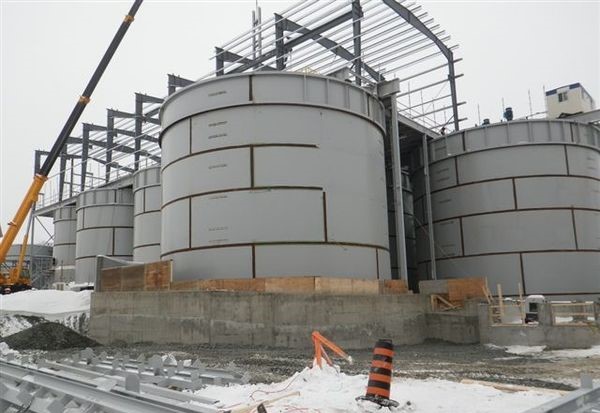
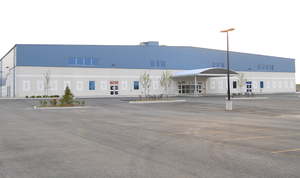
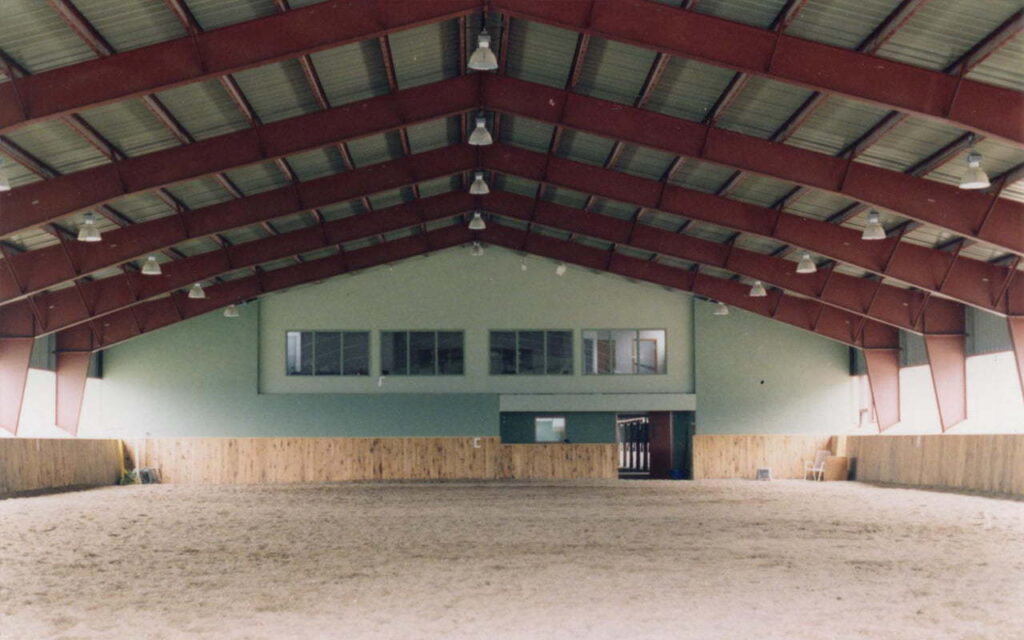
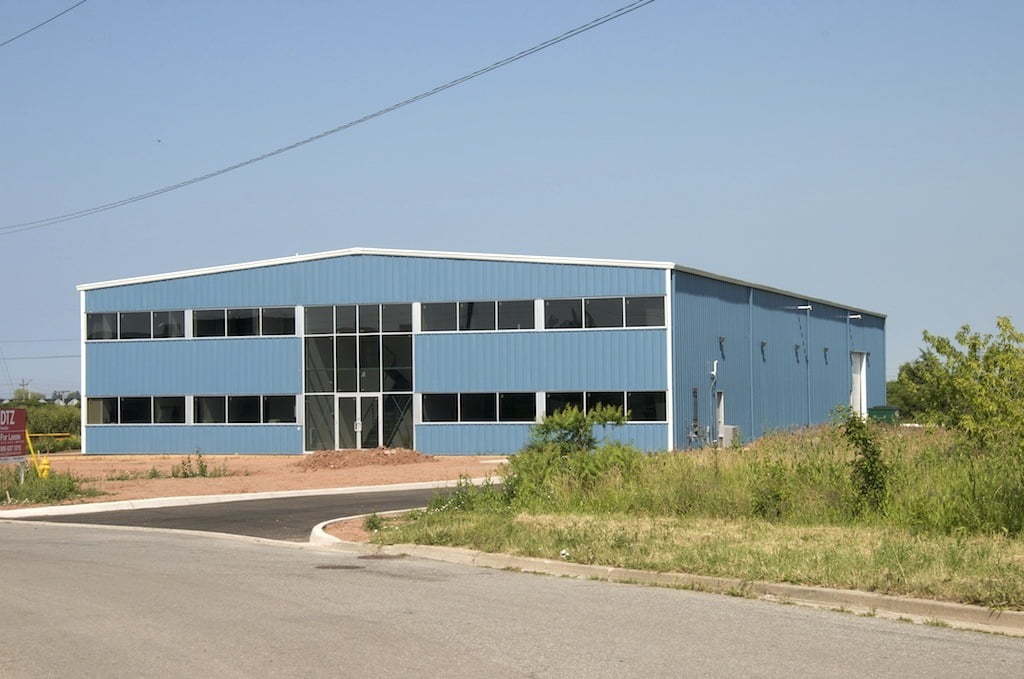
Pre-engineered Metal Buildings effortlessly span 100’s of feet in width and can be as long as your site will allow.
3. Wide is Wondrous
There are not many other types of gabled structures that can span 250 feet or more in a cost-effective manner, without using posts or columns to support the loads. Prefabricated Metal Building Systems are known for their incredible width span.
By far the most frequently used primary framing in a Prefab Steel building system is the Clear-Span Rigid Frame. We call these frames “Clear-Span” simply because they have no interior columns or support between the exterior columns. An amazing thing for customers who are looking for 100% usable interior space!
It is the Clear-Span Rigid Frame that revolutionized construction and made prefab metal buildings such an incredibly versatile and innovative investment.
The typical Rigid Frame on a prefabricated steel building has tapered vertical columns and a tapered rafter. The pre-engineered process can push the clear-span up to 250’ in width.
If you need it wider – No problem, we can use a modular framing system.
Modular frames are simply Rigid Frames with intermediary columns, and the spacing between the intermediary columns does not have to be equal. These extra columns provide strength and integrity to the rigid frame, redistributing the force of the loads to the overall structure. When the rigid frame is not wide enough, Modular Frames can be used to widen the span of a prefab steel building much further.
Furthermore, when they can be hidden within the architecture (e.g., in aisles, bleachers or partition walls), Modular Frames don’t impact the overall design of the interior of the steel structure and can be used to bring the overall cost down.
Closing Out
The amazing capabilities of the pre-engineering process puts the strength of steel exactly where it is needed to create the muscle power that will withstand pressures from the elements. Even without using posts and columns on the inside of your steel building, we can go as wide as 250’ without any extra support – even wider when geographic conditions allow.
The clever use of both types of framing is one way that your experienced Norsteel Building consultant will work with you to achieve the best solution for your specific steel building requirements. Depending on the application for your prefabricated metal structure, we may incorporate both rigid frames as well as modular frames within the same steel building design.
Contact Us Today!
When you buy a building from Norsteel, we become your partner throughout the construction process. We work with you, or with your general contractor, to ensure that all your steel building requirements are met. Your project is our project, and we’ll be with you the whole way through.
For more information on specific steel building applications, click here to learn more about our line of products. If you have any questions or comments, click here to contact us today.
Regardless of complexity, every Pre-engineered Metal Building is unique and requires its own customized design.
4. If you can dream it, we can make it
Pre-Engineered Metal Buildings are custom designed to your exact needs, preferences and specifications. Individual environmental conditions and differing applications combine to make every steel building project and every customer unique. This dictates a customized design for each new prefab metal building system.
Several of our customers have very specialized applications in mind requiring exact and precise calculations and engineering.
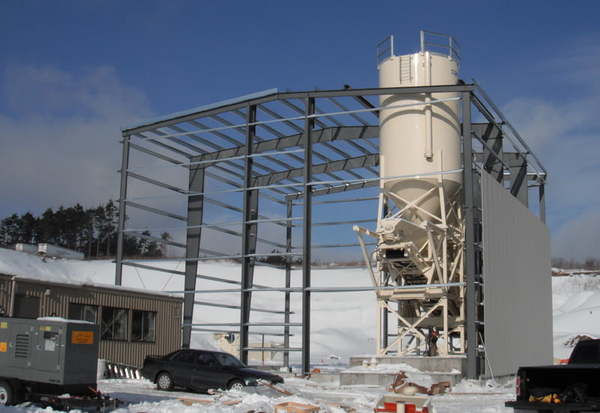
Re: Spartan Ready Mix; Uxbridge Ontario
As manager of Spartan I have been involved since the very beginning of this new company. In the early stages we had planned to enclose our plant inside a building and looked to Norsteel for design and pricing. With the help of our sales consultant we had originally looked at building 40 x 120 x 40 but scaled it back to 40 x 60 x 40 and had it modified to accommodate our silos which would be higher than the roof height. We were very pleased with design and cost. The delivery was on time which was very important to us as we needed to be up and running by spring of 2010 and our timelines were met. 6 years later we are very pleased with our building and in the near future we could be looking for second building or an addition to one we have. In closing we were very satisfied with Norsteel and have recommended them to others and would not hesitate to use them in future projects. I have attached a few pictures of our finished product. Thank you.
Rick Shaw
Manager Spartan Ready Mix
Uxbridge, Ontario
The Pre-engineered nature of these steel buildings allows for each design to be a customized and unique project, without the increased expense usually associated with customized architecture and engineering.
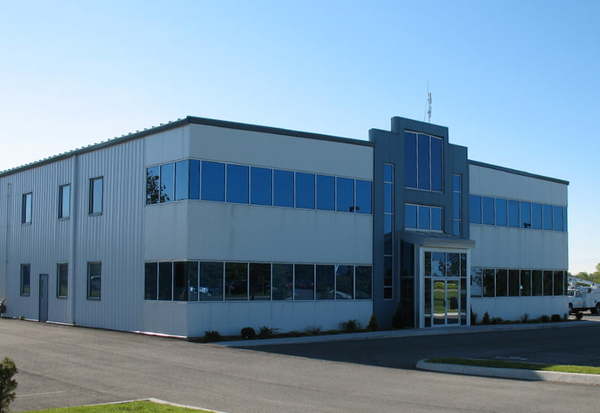
Many customers are surprised by the architectural designs that we can accomplish with our advanced pre-engineering technology. Grand entrances, hipped roof systems, multiple-joined structures, and even multi-level complexes – these are just a few of the limitless possibilities.
Closing Out
The amazing capabilities of the pre-engineering process dictates our ability to design intricate projects. And historically, it was these types of intricate and unique steel building projects that were our focus at Norsteel. Our team of designers have a wealth of experience having worked on complex projects like shopping malls and airports, intricate industrial plants and complicated post disaster facilities.
We’re up for the challenge and love to push the Pre-Eng Metal Building scope just a little further to create designs that were once only accomplished with conventional construction techniques. Your experienced Norsteel Building consultant will work with you to achieve creative design solutions for your specific steel building.
We love a challenge! And chances are, if you can dream it, we can make it!
Contact Us Today!
When you buy a building from Norsteel, we become your partner throughout the construction process. We work with you, or with your general contractor, to ensure that all your building requirements are met. Your project is our project, and we’ll be with you the whole way through.
For more information on specific building applications, click here to learn more about our line of products. If you have any questions or comments, click here to contact us today.
The prefabrication process dictates that we use no more, and no less steel than is exactly appropriate for your specific unique structural design.
2. Waste not, spend not
When designing prefabricated metal buildings, the engineering process inherently creates a structural design with very little waste. This is because it uses the optimal combination of structural components with the exact capacity to suit the specified requirements for that specific job. In other words, the technology we use is designed to ensure that only the exact amount of steel studs are required for each particular steel building.
This means that there is no overage for the customer to pay because there is no unnecessary steel that is wasted in the manufacturing process. This provides for a very lean cost, and it results in a very environmentally sensitive approach to construction.
Understanding that the efficiency in the engineering process creates a cost efficiency for the customer is key to understanding the amazing advantages offered by a pre-engineered metal building solution.
The minimal waste advantage associated with pre-engineered building solutions, also translates to less material waste on the job-site. Exact measurements that correspond to exact details make for easy construction and leave little to no need for last-minute adjustments and on-the-spot improvisations. This translates into high cost savings for the customer when there is little to no cutting or welding on site, both in terms of construction time and in terms of job site clean-up.
Big or small, every job site looks this clean!
Closing Out
The engineering process used to design our prefab metal building systems uses incredibly precise technology to create the design and detailing for your steel structure. It uses exacting measurement design tools to factor in all calculations and in the end, produces exact engineered drawings and a detailed cut list for production. This process means that when we manufacture your steel structure all components are made to those exact specifications, so that only the necessary steel is used to produce your specific metal building.
At Norsteel,we take pride in the fact that our Pre-Engineered Steel Buildings are an innovative, technologically detailed and environmentally sound approach to providing customers with cost-effective, waste-free structural solutions.
Contact Us Today!
When you buy a building from Norsteel, we become your partner throughout the construction process. We work with you, or with your general contractor, to ensure that all your steel building requirements are met. Your project is our project, and we’ll be with you the whole way through.
For more information on specific steel building applications, click here to learn more about our line of products. If you have any questions or comments, click here to contact us today.
Keeping people safe and protecting their investments is always our first priority.
1. Keeping you safe
Pre-engineered steel buildings are used for an endless number of applications. From Restaurant facilities to Churches, Horse stables to chicken ranches, warehousing, automobile storage and office space.
When designing a pre-engineered steel building, local and National building codes are always factored into the design and engineering process. This goes a long way to ensure that your Prefab Metal Building will meet or exceed all structural requirements demanded by the specific environmental conditions of your locations – but it isn’t enough.
Your Building Consultant should have a thorough understanding of what exactly you will be using your steel building for. He or she should ask you how you plan to finish the inside. They should ask for example, if anything will be suspended from the ceiling or walls of your steel structure. This will dictate the collateral loads to be used in order to ensure that your roof is strong enough to sustain any added weight.
Your Building Consultant should also ask how many people will be inside your steel structure at any given time in order to determine the appropriate occupancy rating used in the design of your prefab metal building.
And there are other important design determinants related to the actual positioning of the metal structure on your specific site: Will the steel building be surrounded by any obstructions? Are there surrounding trees or other buildings, for example? Depending on the height of those obstructions, they could have serious implications for snow accumulations on roofs and walls. This snow shadow may increase the loading on the steel structure and must be accounted for in the design of your metal building system.
There are many considerations that should factor into a prefab steel building design, in order to ensure that it is engineered to your specific requirements. This is why each steel building is represented by its own customized specifications and requires its own precise engineering process.
Closing Out
At Norsteel,understanding our customer’s needs and specifications is essential in ensuring that we are providing the steel structure that satisfies your specific project requirements. We take the time to fully and thoroughly understand the complete scope and the tiny details of your project.
Because we understand that no matter the size of the project, and no matter what you are protecting, every steel building customer wants the security of knowing that the building they choose is safe, strong and durable.
Contact Us Today!
When you buy a building from Norsteel, we become your partner throughout the construction process. We work with you, or with your general contractor, to ensure that all your steel building requirements are met. Your project is our project, and we’ll be with you the whole way through.
For more information on specific steel building applications, click here to learn more about our line of products. If you have any questions or comments, click here to contact us today.
In the search for a new building, it is important to explore all possible options. Often, several factors combine to influence which solution will ultimately suit a customers’ building requirements.
It is always important to consider a thorough assessment of your current needs and to compare these to the on-going maintenance requirements of possible building options. It is also important to consider how your structural requirements may change in the future. A customer’s structural needs may change for example, as a business grows over time.
There are several considerations and benefits that are inherent in choosing a structure with all-steel construction. To take this a step further, there are several advantages of choosing a Pre-Engineered Steel Building Solution over many other available steel building types. Here are some of the more popular reasons why customers consistently choose Pre-Engineered Metal Building solutions over all other options.
Pre-Engineered Steel Building Solutions – The Advantages
The benefits of steel as a material are well known in the construction industry:
Product Quality – Steel is a manufactured commodity and product quality is assured. As a material, steel is flawless and free of defect. Steel Studs have no knots, or splits – It is the ideal material for construction.
Steel is endlessly recyclable – Steel is the most recycled material on earth. All new steel is currently produced with recycled steel, making steel construction the ideal choice for the environment. It’s the Green solution.
Steel is non-flammable – Steel doesn’t catch fire. It can contain a fire, it can keep a fire out, and keep it from spreading. Steel is recognized to have an A-Fire Rating.
Long Lifespan – Steel does not decompose. It remains sturdy and durable. Walls remain straight, floors are flat. Steel requires little to no maintenance.
Choosing a Prefab Metal Building System – 15 Advantages
Choosing a pre-engineered approach to any construction makes that system efficient in extraordinary ways.
When we marry this engineering with the strongest material on earth – steel, we have an unstoppable combination of efficiency, durability and strength; at an extraordinary value.
Here are some of the key advantages of choosing a pre-engineered steel building solution for your next construction project. Click on any of the headings below to learn more about that specific advantage.
Safe, strong & durable construction – Local and national building codes are always factored into the design and engineering ensuring that every Metal Building will meet or exceed all structural requirements demanded by the specific environmental conditions of the job site and application. Click here for more information.
Pre-engineered for cost-efficiency – The pre-engineered process creates metal structures with very little waste, which use only the exact amount of steel required for each particular building. Click here for more information.
Ability to span long distances – Prefabricated steel structures can span 250 ft. in width and still be a cost-effective solution. Pre-engineered Metal Buildings effortlessly span 100’s of feet in width and theoretically unlimited lengths. Click here for more information.
Custom design process – Pre-Engineered Metal Buildings are custom designed to each customer’s unique needs, preferences and specifications. Click here for more information.
Clear-span designs – Pre-engineered metal buildings are clear-span by design. This means that there are no columns or posts to get in the way of 100% useable interior space. Click here for more information.
Aesthetically pleasing – Pre-engineered steel buildings can have any look required by the customer. Beautiful exteriors can be created using stucco panels; faux brick and wood siding, vinyl, or stone facades. Click here for more information.
Steel buildings can be fully customized to meet the aesthetic qualities that a customer desires.
Energy efficiency – Pre-engineered Metal Buildings are designed, engineered and constructed to be energy-efficient. Even without added insulation, the temperature inside the structure remains constant, keeping the structure comfortable. Click here for more information.
Insulation packages – Metal Building Systems are compatible with specific insulation packages, making them even more efficient and innovative. Click here for more information.
Single-source responsibility – The fact that one single supplier is responsible for the entire steel building envelope is among the main benefits of choosing a Pre-Engineered Metal building system. Click here for more information.
Ease of assembly – When your pre-engineered steel building arrives to your job site, all components will be well packaged and in bundles that are clearly labelled. Every part will be quickly located and cross-referenced in both the blue prints and the erection manuals when construction begins. And with no welding and minor cutting on site, each component is a perfect fit to each other part, making the structure very easy to assemble. Click here for more information.
Fast construction process – The speed of construction comes from the fact that all building parts are organized, available and at the ready, with no welding and only minor cutting to do on-site. This coupled with the simplicity of the pre-engineered steel building with its limited number of standardized components, allows for quick construction. Click here for more information.
Thanks to the pre-engineering of the building components, the actual erection of your building can take as little as 1 or 2 weeks.
Faster occupancy – Less time spent erecting, equates to diminished construction costs and a faster occupancy. For many retailers and commercial buildings, it is important to understand that time gained is essential in determining the economic benefits of a Steel Building Solution. Click here for more information.
Low maintenance – A typical metal building system, with pre-finished metal panels and standing seam roof, is virtually maintenance-free. Click here for more information.
Flexibility of expansion – Even after years of use, Pre-engineered Metal buildings are easily lengthened to accommodate growing customer needs and requirements. Click here for more information.
Savings Year after year – Energy-efficient, maintenance-free, and durable construction ensure continuous savings year after year. What’s more, some Insurance Companies offer discounts for pre-engineered metal building systems because of their all-steel, optimal fire rating construction. Click here for more information.
More Benefits of Steel Buildings — Better Than Wood
Compared to other building materials, the benefits of steel buildings are readily apparent to anyone that wants a strong yet affordable structure for just about any purpose. But when you consider typical wood buildings, steel provides many benefits that simply can’t be matched by traditional wood construction.
While wood may be the most common way to erect a residential building or to quickly create a structure that may not require the demands of steel, nothing quite beats a pre-engineered steel building when you consider longevity, raw strength and quick assembly. That can help make steel much more viable than wooden buildings that are can be erected in any number of ways.
But with pre-engineered steel buildings, the benefits largely outweigh the costs, and today most commercial, industrial and warehousing projects opt for the convenience and strength of steel over the challenges of working with wood.
Save Money and Build a Better Building With Steel
With the various advantages of steel over wood, it’s true that a steel building can actually cost you less than a comparable wood construction. While the raw cost of a wood building is rather low, you’ll likely end up paying for it over time with numerous repairs and other efforts that will be required to keep that wood building standing and in good order.
On the other hand, a steel building will likely sit just the way it was erected with minimal maintenance or other concerns. Over the life of the building, that can mean substantial savings with a building that doesn’t need much in the way of maintenance. After all, wood warps and rots over time, and those slight shifts can represent huge problems when considering the structural integrity of a building, if not the aesthetic ones.
Instead of regular maintenance and other efforts to determine whether your structure is deteriorating in a way that could be unsafe, the advantages of steel construction means that your steel building can actually end up appreciating in value instead of the opposite, primarily because steel buildings stand the test of time. If you end up in a position where you need to sell your building and the land it sits on, that could help put more money in your pocket.
More Strength and Durability
As opposed to wood buildings, which may go up strong and eventually succumb to the elements without proper maintenance and fixes, a steel building is essentially impervious to it all. Rather than winds and storms causing damage, the benefits of a steel building means that your building won’t be any worse for the wear as time passes.
Furthermore, because steel is steel, you won’t have to worry about termites and other pests that can make owning a wood building a pain. Due to inconsistencies in wood products, you may also experience up to about a fifth of the purchased wood going to the scrap pile, which can represent a considerable expense. That’s why even though a wood building may be cheaper to originally erect, the costs quickly align themselves because steel is simply a better and more consistent product.
Indeed, most modern pre-engineered steel buildings are created to withstand the worst that nature can offer, including protection against earthquakes, hurricanes, tornados, high winds, heavy snowfall and flooding, among others. In general, steel is one of the strongest building materials on earth, and even when faced with fire it will reject burning. It’s one of those great benefits of steel buildings, and why many are turning to steel for their next building project.
Final Thoughts
The benefits of steel are well known in the construction industry.
Steel, as it comes from the steel mill, is incredibly versatile. It is this versatility that provides engineers with the flexibility to design steel structures with a high degree of accuracy. Steel is a plentiful resource – we have an abundance of it, and it is a well-accepted material world-wide. Steel has a very high degree of workability, and can be manipulated easily. It can be cut, and welded; shaped and formed so that it satisfies an endless array of requirements. And Steel is resilient. It can take a great deal of abuse and it doesn’t wear down like other materials. Finally, and perhaps best of all, steel is recyclable, and through the recycling process, it does not lose strength.
When we consider that steel is the fundamental construction material of all our Pre-Engineered Steel Buildings, we can see how the benefits and advantages keep adding up: Cost efficient in every way – from materials; to freight; ease of assembly and faster occupancy. Pre-engineered Metal Buildings are virtually maintenance-free and easy to expand; adding continuous value year-over-year in savings and worry-free, enjoyable space.
Contact Us Today!
When you buy a building from Norsteel, we become your partner throughout the construction process. We work with you, or with your general contractor, to ensure that all your steel building requirements are met. Your project is our project, and we’ll be with you the whole way through.
For more information on specific metal building applications, click here to learn more about our line of products. If you have any questions or comments, click here to contact us today.
You can use steel for all sorts of projects including agricultural, livestock, sporting arenas, mining, commercial and so many more. The possibilities are endless, even for do-it-yourselfers.
On behalf of everyone at Norsteel Buildings, we sincerely hope you and your family are healthy and safe. This page is dedicated to providing updates on the steps that we at Norsteel are taking to address challenges arising from the COVID-19 pandemic.
First and foremost, the safety and well-being of our customers, partners and employees remains our primary concern. We have been closely monitoring the situation and following the guidance and direction from the Canadian government, healthcare professionals, and the World Health Organization. As such, we are taking a number of precautions to help limit the spread of the virus including maintaining a fully remote team.
Our staff are still available remotely and are ready to service you in whatever capacity you require:
For those of you who have purchased a Norsteel building, we will continue to update you as our situation changes with our business and that of our manufacturing partners. In the meantime, whether you have questions about your timeline, engineered drawings or your delivery date, please contact us by phone or email directly.
For those of you who have been working with one of our consultants, we respect the fact that during this time of uncertainty, you may wish to delay your building project. For you, know that we are here waiting to continue our conversation when things have settled down and you are ready to move forward. No pressure.
Lastly, several of you have recently made inquiries about a new steel building purchase from Norsteel and we want to let you know that we are still available to help. You may find yourselves with time to research and ask questions in preparation for a future purchase. Give us a call today to continue our dialogue so that we can help you plan for brighter days.
Don’t Hesitate to Reach Out
Whatever your situation, we remain focused on delivering a customer service experience that is tailored directly to your current needs. Please call us at (866) 971-7575 if you have any questions or concerns.
In their search for a new building, many of our customers quickly recognize the benefits of a steel building solution. But there are different types of steel buildings, and not all offer the same efficiencies and benefits. There are four main types of steel buildings that can fall under the umbrella of being pre-engineered solutions. These are the Quonset Hut and its arch-type variants, the C-channel Metal building; the traditional Rigid Frame Metal Building system and the Hybrid steel building solution. Each of these steel building solutions has its merits, advantages and disadvantages; and each is better suited for specific functions and applications. We have explored the Rigid Frame and C-channel in great depth in previous blogs, let’s now turn our attention to the Quonset Hut and other arch-type steel structures.
Quonsets & Arch-Type Structures
The Quonset Hut was the first pre-engineered steel building which was originally manufactured as a temporary structure used during the World Wars. It consisted of pole arches with sheets of metal cladding lain over top, that were incredibly easy to transport and because of their stack-ability they could be easily assembled, and re-assembled, on the war front.
One feature most appreciated during this time was the ability of the structure to contain and lift when a bomb was detonated inside of it. And of course, because they were entirely made of steel components, the Quonset Hut was fire-resistant.
Tip: The Quonset and all arch-structures, like the C-Channel and Rigid Frame Metal Building Systems are made from 100% steel components. As such, they share an “A”-Fire Rating. Many customers don’t realize that this non-combustibility factor can save significant money on insurance premiums for the life of their pre-engineered steel building.
The Arch – Strength and Integrity
The Quonset Hut serves many great purposes – and truth be told, I have a bit of a protective affiliation for it, because it was the first steel building I was taught to recognize, and to sell. The most amazing thing about the Quonset, is that the integrity of the entire structure remains entirely dependent on the integrity of each individual arch. And anyone who has traveled to Europe and witnessed the historical architecture there, understands the strength of that arch.
That the arch provides the structural support for the building means that all Quonsets have clear-span interior. As is the case for all pre-engineered steel buildings, columns and posts are not required for structural integrity. This means there is nothing to get in the way of 100% usable interior space.
Quonsets are pre-engineered, requiring conformity to National Building Codes and loadings. This means that like all pre-engineered steel buildings, Quonsets must be custom engineered to withstand the loads and codes of the specific location in which they will be erected. Simply speaking, the gauge of the steel determines the ultimate strength of the structure – the lower the gauge of steel, the thicker and stronger each arch will be.
The arches of a Quonset are deep corrugated galvalume steel, and the corrugation itself provides added structural strength to the overall structure. It also provides the exterior of the building so that it is structure and covering all in one. This is part of the economical design of the Quonset – The surface and structure are one in the same.
Depending on the width of the structure, several segments are bolted together to form each individual arch and each arch is then bolted to the next arch in sequence. The arches are anchored to a foundation – usually a floating slab. An industrial base plate which connects the arches to the foundation, is arguably one of the most important components in the construction of all Arch-type steel structures. This plate is extremely valuable to line up the arches properly without any torch or twisting.
Tip: If you are buying a Quonset, make sure to include the base plate connector in your overall cost. This important component, is an optional feature that you don’t want to overlook.
The first Quonsets were frequently referred to as dome structures. Their shiny, half-moon shapes adorn many of our Canadian provinces as it quickly became a fantastic solution for agricultural applications, especially in terms of livestock housing, and crop storage. But customers soon understood that there was a significant amount of space that was being lost on the sidewalls of the Quonset. Because of the structural design of the arch, the sides of these original steel structures, are not vertical and this loss of space on the sides of the structure quickly adds up.
Tip: In comparing Arch-type steel buildings with other pre-engineered building systems one very important factor for customers to consider is the height measurement. The height of an Arch building is taken from the center of the highest component – the highest point of the arch. The height of a c-channel or rigid frame instead, is taken at the EAVE HEIGHT (not at the peak) – where the sidewall meets the roof. For example, an arch building with a listed height of 12′ may be comparable to a gable building with a height of 9′, depending on the pitch.
Structural Security & Aesthetic Appeal
In an effort to deal with this lost space, Quonset manufacturers created several different models of the original arch building.
And although in many of these new designs, the lost space is minimized, there has been a trend away from these arch-type structures for two main reasons: high snow loadings and, aesthetic appeal.
In the last few decades there have been many incidences of unexpectedly high snow fall mixed with heavy rain, in many regions of North America. These unprecedented weather conditions caused structures of all types to collapse. Naturally, the devastation and loss of property evoked significant concern and resulted in the implementation of new and stringent National Building Codes. These new codes in turn, had the effect of limiting the use of large, arch-type structures in many areas, because the gauge of the steel required to pass approval was so thick that it increased the overall building cost dramatically. Quonsets became comparable to other traditional pre-engineered steel building alternatives in terms of price, and were no longer the affordable option for large-scale projects.
Tip: The types of loads and their magnitudes are critically important to the design and construction of any pre-engineered steel building. Both the location of the site where a building will be located, as well as the location and positioning of the building ON THAT site, are extremely important in determining the integrity of any pre-engineered steel structure. If a building is going to be located in an area with obstructions, other buildings or trees for example, then that building must be engineered to withstand the additional snow that may occur as a result of the snow shadow – that is, the redirected snow accumulations that are caused by the positioning of those obstructions, in relation to the steel building. Today, Pre-engineered Steel Building suppliers are very weary of obtaining this vital information from customers. When discussing your project, be certain to share information about your site with your Building Consultant.
At about the same time that the NBC became more stringent, many municipalities also passed Bylaws prohibiting the use of arch-type structures in commercial and residential areas, based on their aesthetic appeal. Several lobbyist groups took up against the shiny surface of the galvalume arches, saying they looked unconventional, industrial and unattractive in municipal areas with high frequency and residential space.
Since it is generally not recommended to apply paint to the arches of these structures, aesthetic creativity and customization are generally limited to the Endwalls of these metal buildings. Many customers are happy to build their own Endwalls out of wood or steel panels in order to adorn the front of their metal building systems.
Tip: If you are buying a Quonset, make sure to find out if both Endwalls of the structure have been included in your cost summary. Many suppliers consider the Endwall an optional feature and include it at an additional cost to the standard kit.
Another factor for some customers is that Door and Window Openings are typically limited to the Endwalls of the Quonset. Recall that the single most important factor in establishing structural integrity in the arch building, is the arch itself. It follows that placing openings on the sides of the arch requires extensive engineering to ensure integrity – at an increased cost. The limited use of door openings on the sides of the structure has implications for both aesthetics and functionality.
All of these things combined have made arch-type structures applicable to a very specific consumer market: Typically those looking for large structures in areas with little to no snow fall; and those customers who are looking for smaller buildings – up to approximately 35’ in width, for use as Backyard shops and garages. Often these buildings are marketed as do-it-yourself kits and, although it can be tedious and time consuming to bolt together each arch into the next with thousands of bolts, the main challenge for DIY customers is to maintain the alignment of the arches without twisting during the erection process.
Tip: As mentioned previously, make sure to discuss the inclusion of the base plate connector in your building quote. This connector will help to diminish the twisting of the arches during construction. Equally important, if you are considering an Arch-type steel structure, find out if your supplier has included the butyl rubber caulking in your cost summary. Many suppliers consider this caulking an optional feature and include it only at an additional cost to the standard kit. But Butyl rubber caulking applied between the arches during the construction process has been shown to reduce the possibility of water leakage in these buildings. It is extremely difficult to apply effectively after the building has been erected.
Closing Out
There is little doubt that the Quonset Hut and other arch-type structures have provided valuable structural space for many customers.
Once a very affordable steel solution, arch-type structures have suffered in popularity as changes to the National building codes and to municipal bylaws imposed stringent guidelines that restricted their use in areas with high snow loads, and in several residential and commercial zones.
As a result, the Quonset Hut and other arch-type steel structures, have become limited to servicing a very specialized segment of the consumer market. Their increased costing and issues with aesthetics, have inspired customers to look into other types of pre-engineered metal building solutions in order to get the benefits previously sought from the Quonset. Pre-engineered solutions, like the C-channel, are beginning to replace smaller arch-type structures because they offer the same do-it-yourself construction, with a more traditional aesthetic appeal and at a comparable cost. And for larger buildings with wider constitutions, Pre-engineered Rigid Frame steel buildings have become an alternative solution, especially in areas where environmental conditions are of high consideration.
Contact Us Today!
When you buy a building from Norsteel, we become your partner throughout the construction process. We work with you, or with your general contractor, to ensure that all your building requirements are met. Your project is our project, and we’ll be with you the whole way through.
For more information on specific building applications, click here to learn more about our line of products. If you have any questions or comments, click here to contact us today.
Historically, people have turned to wood for construction because it is a familiar material that is “user-friendly”. Pole Barns and wooden structures are some of the most common building structures around. A century ago, wood was easily the best choice for materials and was found in abundance all over the world. It was inexpensive, readily available and owners usually designed and built their own structures because it provided a flexible and very forgiving erection process.
Despite the initial savings in price, over the years, steel construction has become more popular and presents significant advantages over wood. Pre-engineered steel buildings are now the method of choice for most commercial, industrial and warehouse applications. Even the agricultural and livestock sector, which traditionally has relied heavily on wood for construction, is switching to steel.
Here are some of the reasons why steel structures have become the preferred alternative to wood construction.
Comparing Pre-Engineered Metal Buildings to Structures Made from Wood
Greater Structural Strength and Integrity
Steel building components are manufactured to very rigid standards and specifications. There are no seconds or substandard materials in a pre-engineered metal building. Each part in a metal building meets strict industry standards in terms of strength; and is designed specifically for its pre-determined use in that specific metal building. This is important as we discuss the custom requirements for each particular job: Every component in a steel building is designed and manufactured to meet the strict load criteria in each individual structure, ensuring that each steel building will handle all the load requirements of its specific site location. Because of this, properly designed and assembled metal buildings have withstood hurricanes, tornadoes and extreme conditions worldwide.
Quicker, Easier, and Less Expensive to Construct
Each pre-engineered steel building component is designed and made specifically for your building. Each component is designed and manufactured to match perfectly with the others. Each piece is labelled and easy to identify and each piece is cross-referenced on the assembly drawings. This means that your steel building – regardless of size, will arrive as a perfect kit, and each piece will fit together precisely. Because each component is detailed and specifically made for each particular structure, erecting the building is quick and easy. In turn, because Steel buildings are assembled quickly and easily, they require less labour. There is little to no waste and little to no cutting, sawing or welding on-site.
Wood buildings take much longer to erect than pre-engineered packages, simply because all the components are sourced and acquired separately. There is more measuring, more cutting, more margin for error and all of this takes a significant amount of time. It also produces much more waste in total, as components must be made to fit once they arrive to the job-site.
One last consideration is that the price of wood is constantly fluctuating. Frequent lumber shortages drive the cost of wood up. This encourages the use of “green” wood in construction projects which can result in warping, cracking, and splitting. These cracks in the wood members effect seal-ability, which decreases both the energy efficiency and the structural integrity of the final structure.
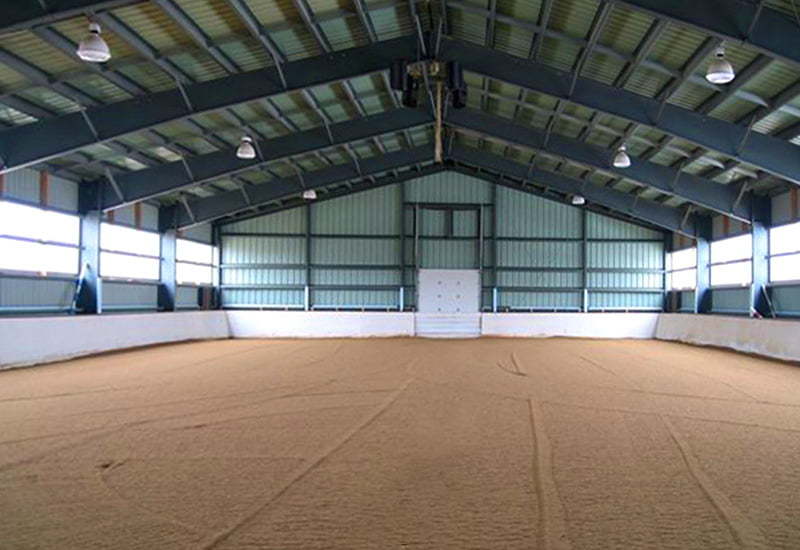
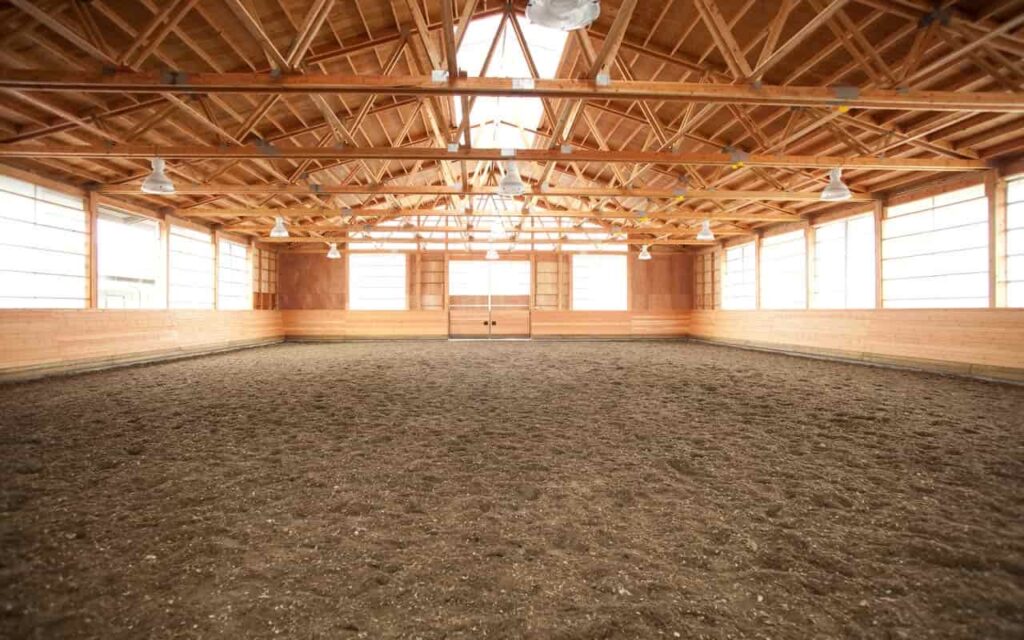
Riding arenas, like those pictured above, can be built in either wood or steel but steel components are quicker to assemble, safer over the lifetime of the building, and more affordable than wood.
Safer – Over the Lifetime of the Building
Steel components won’t weather or degrade over time like wood. Steel won’t decay. Steel will remain rigid for the life of the building. This structural strength means less stress on fasteners and components; which in turn provides a safer building for years to come.
Alternatively, owners of wooden structures need to invest in continuous maintenance. With wood, wherever there is moisture close to the base, there is an opportunity for decay. Decay causes structural insecurity and increases the risk of collapse. To deal with the natural properties of wood, most wood posts are pressure treated, but this process can be poisonous to livestock or other animals if ingested.
Importantly, wood carries with it the fear of loss due to fire. One very real peace of mind that comes with choosing a Steel building is the security that your people, livestock, and your property, are safe; because steel is non-combustible.
Greater Design Flexibility
Wood structures require more interior columns for support. This takes up valuable floor space that could otherwise be used.
Because steel is much stronger than wood, it allows for much greater design flexibility. You can typically span the entire width of your building with no interior posts required and the columns can be set further apart on the sidewalls. The result is a much more open building with less weight and greater structural integrity.
When wood trusses are used to accomplish wide open spaces, they must be layered and joined in several places. This increases costs exponentially. This is why wood structures typically involve several interior posts and beams that limit the useable, clear span area, decreasing work space.
Lower Maintenance Costs
Steel components won’t warp, split, twist, swell, shrink or decay, like wood. Steel components will not have to be replaced or repaired and will remain long after the wood frame building is gone.
Pre-engineered metal buildings use a minimum heavy 26-gauge sheeting for roofing and siding, as opposed to the light 28 or 29 gauge material used on most wooden pole barns. Fasteners are also higher quality for steel buildings and won’t need to be replaced like on a typical wooden pole building. The light gauge metal sheeting on most wood pole buildings will require replacement over time, and wood runners hold moisture against the light gauge metal sheeting, causing the sheeting and the fasteners to rust prematurely. In such cases, the fasteners lose their grip and the sheeting becomes loose requiring repair or replacement. Additionally, regular high maintenance is required to escape rodents and burrowing insects, and to limit the amount of rot and mold in wooden structures.
When you chose a pre-engineered metal building, these things are not issues. Steel Structures are virtually maintenance-free.
Longer Economic Life – More Durable and Worry-Free
Steel offers maximum functionality while still maintaining the aesthetic quality many seek from wooden buildings.
Steel buildings simply don’t wear out over time like wooden structures. Barring some catastrophic event, your steel building will last a lifetime. Wooden buildings have an economic life of 15-20 years and require lots of maintenance along the way. After approximately 7 to 10 years, wood siding and roofing will have to be replaced. If non-metal roofing is used, it will also require replacement at some point. And as a wooden structure ages, wood members naturally dry out, which causes shrinking, warping, swelling and cracking. Preventing the wooden structural members from drying out is necessary to maintain a secure structure but requires continuous maintenance and a watchful eye.
In contrast, a pre-engineered metal building requires virtually no maintenance and provides decades of worry-free service.
Stronger Foundation
One of the first objections some people make to a steel building is that it requires a concrete foundation and floor, adding significantly to the initial cost of the project. A metal building doesn’t always require a full slab, although it does require concrete piers at each column location to provide proper structural stability and meet design load requirements. The required piers provide load bearing capacity and an above grade connection so that the posts are not subject to moisture and decay. Foundation requirements are dependent on building applications as well as site location. Local permit offices will assist in dictating which foundations will be deemed appropriate for specific buildings and municipalities.
While the foundation does add to the initial cost of a metal building system, the advantages over the life of the building are tremendous and outweigh the original expense.
Steel Construction is Better for the Environment
Steel is 100% recyclable and is the only recycled material that doesn’t lose strength when it is recycled. Remember that there is also no waste when a steel building is manufactured and erected, because no substantial cutting is required on-site and all cut-offs at the factory are recycled.
When compared to wooden construction which is wasteful and non-recyclable, Metal buildings are the best choice for the environment.
Steel Buildings Can Actually Save You Money – Year after Year
Apart from continuous savings related to maintenance, steel buildings are recognized with an “A” fire rating. Wood buildings instead, have a “C” rating for fire. Generally speaking, what that means is that a wood structure is more likely to burn. Many customers don’t realize that this non-combustibility factor can save significant money on insurance premiums for the life of their pre-engineered steel building.
Closing Out
Steel buildings offer many advantages over wood structures.
At first glance, the price savings afforded by a wood building may seem very attractive to customers. But when comparing different solutions for required construction, we recommend that our customers consider all the factors.
Compare all the costs – not just the initial costs for site prep, materials and labour, but also the longer term costs of ownership – costs like maintenance, repairs, and insurance. Decide how much value you place on safety and environmental friendliness, too.
When considering all the advantages, customers agree that the value of a pre-engineered steel building far outweigh the initial cost savings of a building made from wood.
Contact Us Today!
When you buy a building from Norsteel, we become your partner throughout the construction process. We work with you, or with your general contractor, to ensure that all your building requirements are met. Your project is our project, and we’ll be with you the whole way through.
For more information on specific building applications, click here to learn more about our line of products. If you have any questions or comments, click here to contact us today.
Most customers who are looking for a steel building have a very good idea of what they want their end project to look like. Many customers are familiar with the basic concepts and terminologies that are used to discuss structures in the Metal Building industry. All customers can benefit from a good understanding of measurements and dimensions as they process the information that they receive from their metal building provider and interact with their building consultants.
In this blog, we provide an overview of the pre-engineered steel building system. We will share some of the more popular steel building designs and go over the basic concepts of a metal building system. It is important to take some time to explain the important measurements that customers need to know and understand before they begin their search for a metal building provider.
The Metal Building System
Steel, also known as red iron, is used across a multitude of industries in the construction segment.
The Properties of Steel – What Makes Steel so Great?
The primary advantage of a steel building is its strength. Steel, as it comes from the steel mill, is incredibly versatile. It is this versatility that provides engineers with the flexibility to design Norsteel steel buildings with a high degree of accuracy. Steel is a plentiful resource – we have an abundance of it, and it is a well-accepted material world-wide. Steel has a very high degree of workability, and can be manipulated easily. It can be cut and welded, shaped and formed so that it satisfies an endless array of requirements. And steel buildings are resilient. They can take a great deal of abuse and it doesn’t wear down like other materials.
Finally, and perhaps best of all, steel is recyclable, and through the recycling process, it does not lose strength.
Building Designs
All our consultants here at Norsteel Buildings are trained to identify each customer’s specific structural requirements. Requirements are then matched to the steel building design which will fit that customer’s particular metal building specifications. Different applications and different site locations may require different designs, and not all steel buildings are created equally. Even what looks like a simple box has to be engineered to exact specifications.
At Norsteel, we supply pre-engineered steel buildings in all shapes and sizes. Because of their versatility, these steel buildings can be engineered to join to each other and to existing structures, creating an unlimited array of shapes and configurations.
Here are some of the more typical metal building designs:
I. Double Slope/Gable Steel Building
The gable steel building is a symmetrical steel structure – it is by far the most common Norsteel metal building design produced. It offers an unlimited number of optional features and is used for an unlimited number of applications.
Double slope metal buildings can also be designed to be a-symmetrical, when customers require that the peak be off-set for a specific application.
II. Single Slope Steel Building
The single slope metal building is used for several specific applications ranging from agricultural storage, to commercial facilities with solar panel installations. Single slope steel buildings are well suited in spaces with multiple structures to accommodate snow shadow from existing buildings. The single slope steel building is designed to be self-supporting.
III. Lean-To Steel Building
A lean-to steel building is designed to attach to another steel building system, or to an existing structure. It typically uses the structural support of the existing structure on the attaching side. Typical uses include car ports; porches; and drive through windows for fast food restaurants.
IV. Steel Structures with Mezzanines
Several metal building projects require a second floor. When the mezzanine is attached and supported by the metal building, it must be engineered to maintain the structural integrity of the metal building system. Norsteel can supply pre-engineered steel structures with up to 3 floors. These can be designed as partial mezzanines for viewing galleries, or full mezzanines to provide complete upper floor space.
V. Steel Structures with Cranes
Several metal building projects are designed for warehouses, mines, and manufacturing plants and must be pre-engineered to support 5-, 10-, or even 20- ton, cranes. Some steel structures have several cranes in each building. Our crane buildings are designed with a standing seam roof system to prevent leakage resulting from vibrations caused by the auxiliary load of the moving crane.
Basic Concepts of Pre-Engineered Steel Structures
Most metal building systems have four outside walls. Two of these walls we call the sidewalls and the other two walls we call the endwalls. As their names imply, the Sidewalls of a steel building are located where the roof meets the walls in a line that is parallel to the ground. In other words, Sidewalls are a consistent height. In contrast, the endwalls are not a consistent height (unless the roof is perfectly flat – which is not typically the case in pre-engineered steel buildings). The height of the endwall changes where the walls meet the roof line. Endwalls are named either left or right. Sidewalls are either front or back.
Tip: Many customers think of the left endwall as the front of their building. Make certain you are in alignment with your consultant when you are discussing each wall of your steel structure.
The line where the sidewalls meet the roof on a steel building is called the eave. It usually has trim to make it look nice in appearance and gutters to remove rain flow from the roof. The distance from the bottom of the base plate to the point where the roof meets the wall, or the eave, is called the eave height.
Tip: The eave height is important because in steel structures, we measure the height of the building according to the eave height (not the peak height). Some municipalities impose a total height restriction. If this is the case in your municipality, then your building consultant needs to be informed so that your eave height can be calculated accordingly.
In steel buildings, we refer to the spot where the two sides of the roof meet on the highest point of each endwall as the peak or ridge. The gable instead is the triangular section that runs from each eave line to the peak and from the eave line on one sidewall to the eave of the other sidewall.
Metal Building Packages from Norsteel all come equipped with trim to enhance appearance. The line where the endwall meets the roof is finished with a piece of trim known as rake fascia. The line where the sidewalls meet the endwall is finished with a piece of trim known as the corner trim. And the peak receives a plastic or metal cap that we call a peak cap.
Tip:Trim packages can be an effective way of enhancing the appearance of your steel building system. Trim is available to customers in several standard colours.
Measurements of Pre-Engineered Steel Structures
A thorough understanding of the measurements that determine size and appearance of a steel building is incredibly important both from an aesthetic and functionality point of view.
Roof Pitch
The roof pitch or slope is usually shown as rise over run.
Typical steel buildings can be designed in several different pitches, but depending on their width and application, most steel buildings are designed with a pitch that is ½-in-12 (.5:12 or .5/12), 1-in-12 (1:12 or 1/12), 2-in-12 (2:12 or 2/12) and 4-in-12 (4:12; 4/12).
For small steel buildings, like in the case of a backyard shop and garage, a roof pitch of 2/12 is by far the most common. Larger steel buildings, like warehouses or arenas, typically call for a 1/12 pitch. For buildings requiring a more traditional, residential appearance, a more defined peaked appearance such as an 8/12 pitched roof may be desirable.
Tip: When we are speaking of roof pitch we are looking at how much of a peak the roof will have. Although many customers consider the roof pitch to be incredibly important in order to establish the ideal aesthetic appearance for their steel building, the degree of slope also has intense importance in terms of snow and rain accumulation.
Inches are used as the basic unit for roof pitch. For example, a 2:12 roof pitch means that the roof rises 2 inches for every 12 inches measured horizontally.
Dimensions & Measurements
Like every other product in this world, steel building systems have three basic dimensions: width, length and eave height.The width is the distance from the outside of the sidewall girt on one side to the outside of the sidewall girt on the other side. The length is the distance from the outside of the endwall girt on one end to the outside of the endwall girt on the other end. The eave height is the distance from the finished floor to the point where the roof meets the sidewall.
Tip: When you are speaking with your steel building consultant, make absolutely certain that the dimensions you are discussing are clear. All metal building providers use out-to-out measurements. The interior space will be reduced in order to compensate for the rigid frame itself. If you require a definite clearance within the building, you must make certain to tell your consultant.
The most important message here is that all dimensions are taken from the outside edge of the girt to the outside edge of the girt. Clarifying these “out-to-out” measurements is crucial.
Final Thoughts
When we first meet with our customers, most of them already have a basic understanding of their structural requirements. They know how they want to be able to use their building and what needs it has to satisfy; and they have a good idea of how they want their finished structure to look.
When you are collaborating with your steel building consultant, be sure you are on the same page. When discussing locations for windows and service doors, it is important to be clear where they should be located; when talking about garage door openings or hangar door locations, it is important to understand the clearance factors involved; and when you are discussing interior clear-span, usable space, it is important that you are calculating dimensions based on out-to-out measurements.
Having a basic understanding of the concepts and terminologies used in the Metal Building industry will help customers to ensure that they are communicating the essential information to their steel building consultant. But don’t be overwhelmed.
Your building consultant is an instrumental resource in assisting you to ensure that all your needs are communicated and met. It’s our job to walk you through the entire process and to make sure that your finished steel building is exactly as you envisioned it.
Contact Us Today!
When you buy a building from Norsteel, we become your partner throughout the construction process. We work with you, or with your general contractor, to ensure that all your building requirements are met. Your project is our project, and we’ll be with you the whole way through.
For more information on specific building applications, click here to learn more about our line of products. If you have any questions or comments, click here to contact us today.
In a previous blog we discussed the different Metal Building Systems in the Norsteel Product line. We touched on the basic concepts and terminologies that are important for customers to understand, as they work with their Building Consultant to design the steel building that will ultimately meet all of their requirements.
As mentioned, Norsteel’s Rigid Frame Steel Building Systems, are by far our most versatile product line. Rigid Frame Metal Buildings can be customized to accommodate unlimited applications and project needs.
This is precisely because of the way they are engineered.
In this blog, we go over the structural support system of Rigid Frame Steel Building Systems. A general understanding of the structural support components will help customers to gain an appreciation of how all the components work together to provide integrity and structural support for their steel buildings. This knowledge is what allows us at Norsteel, to provide our customers with innovative, cost-saving solutions. Because once you understand how the pieces go together to produce strength and support, you also know how to provide unique design solutions without sacrificing that integrity. This in turn, allows us to be creative in our approach to every steel structure.
Rigid Frame Metal Buildings
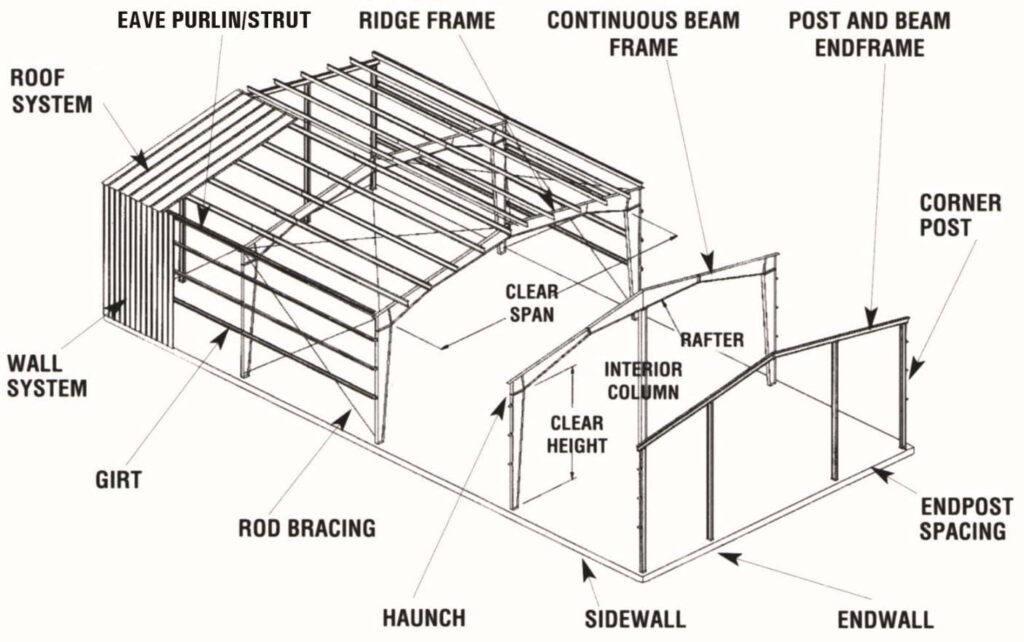
This diagram provides an inclusive look at the main components of a rigid frame metal building system. Not all steel structures are pre-engineered with all of these components. There are options and necessities which are dependent on the steel building application, the size and, the specific building codes and loadings for your particular building on your particular site. Several components must be added when there is, for example, a mezzanine or a crane in the building; or when there is snow shadow or significant point loads. But for the most part, this diagram is a good place to begin your introduction to the basic elements that make up a simple metal building system with a Rigid Frame.
The Structural Support System
The Structural Support System of a Pre-engineered steel building is divided into 3 main parts:
The primary support system
The secondary support system and,
The bracing system
These 3 structural systems are engineered to absorb the loads and forces that are acting on the building and they transfer those loads into the foundation system.
1. The Primary Structural Support System
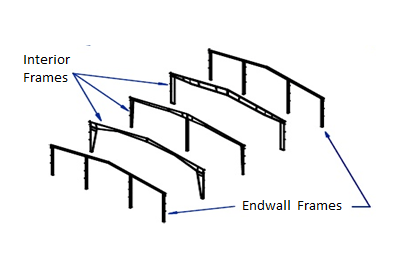
When we speak about the Primary Structural Support of a Pre-Engineered Steel Building, essentially, we are addressing the framing of the building. The Primary structural support system is the main support of a pre-engineered steel building. For this reason, we often refer to the primary structural support systems as the main framing system of the building. It follows that when a frame is at an Endwall, it is called an Endwall Frame, and when a frame is within the building, it is called an Interior Frame.
Rigid Frames and Endwall Frames are laid out in a carefully engineered pattern to provide the primary support for the building. The distances between the centerline of each of the frames is called a Bay. Bay Spacing is an important factor in determining the design of your structure. The required width of each bay is something that customers should consider because it will have an effect on where you are able to place windows, service doors, and larger garage, overhead and bi-fold doors along the sidewalls of your steel building.
Rigid Frame Support
The rigid frame is the most commonly used frame in pre-engineered Steel Building Systems, and so it stands to reason that it is responsible for why we identify this as a Rigid Frame Pre-Engineered Steel Building. It is the Rigid Framing System on a pre-engineered steel building which offers the structural integrity to this construction. Without the Rigid Frame, there is no pre-engineered solution.
Generally speaking, a Rigid Frame is designed to bear the load for half the bay of the roof on either side of its location.
Although the majority of Rigid Frames are typically clear-span in design, the Rigid Frame is also available in a modular version.
Rigid Frames are either Clear Span (no interior columns) or Modular (with columns). Modular frames have 1 or more interior columns between the exterior columns, that are responsible for supporting some of the vertical load that is carried by the frame.
Tip: A Rigid Frame can be used in the interior framing as well as at an Endwall of a steel building
Clear Span Rigid Frames
By far the most frequently used primary framing in a Pre-Engineered Steel building is the Clear-Span Rigid Frame. We call these frames “Clear-Span” simply because they have no interior columns or support between the exterior columns. An amazing thing for all customers looking to achieve 100% usable interior space! In fact, it is the Clear-Span Rigid Frame that revolutionized construction and made metal buildings such an incredibly versatile and innovative investment.
The typical Rigid Frame on a steel building has tapered vertical columns and a tapered rafter. These are the I Beams of the steel building – meaning that if you took a cross-section through either a column or rafter section, you would have an I-shape.
Typically, the rigid frame is thickest in the area where the column is connected to the rafter beam. We call this area, the Haunch. The haunch is the thickest part of a Metal Building system simply because it is a load bearing spot in the building – it must support great force, and so, we must reinforce that area with steel.
Tip: Often, we have a customer who is trying desperately to achieve every square inch of usable space. In such cases, we employ a straight column rigid frame instead of our standard tapered column. This also comes in handy when we are trying to achieve a certain clearance under the haunch that we would otherwise not be able to accomplish. Rigid, Clear-span Frames with straight columns are usually less cost effective because they require the building be fortified in other (less ergonomic) areas.
Modular Rigid Frames
Often, a customer does not take issue with having a clear-span design. In such cases, we have the option of using a Modular Frame. Modular frames are simply Rigid Frames with intermediary columns, and the spacing between the intermediary columns does not have to be equal. What is important here is the understanding that these extra columns provide strength and integrity to the rigid frame, redistributing the load of the force exerted on the haunch. And because the columns provide strength and integrity to the overall structure, Modular Frames can be used to bring the overall cost of a structure down. When used where they can be hidden within the architecture (e.g., in aisles or bleachers) the use of a Modular Frame does not impact the overall design of the interior of the steel structure.
The clever use of both types of framing is one way that your experienced Norsteel Building consultant will work with you to achieve the best solution for your specific building. Depending on the application for your steel building, we may incorporate both rigid frames as well as modular frames within the same design.
Tip: The dimensions between interior columns are measured from the outside of the sidewall girt to the center-line of the first interior column. On all other interior columns, the column spacing dimension is measured from the center-line of one column to the center-line of the next column, until the last interior column is reached. The column spacing on the last interior columns is again measured from the center-line of the column to the outside of the sidewall girt.
Post & Beam Endwall Frames
The most common Endwall frames are called Post and Beam Endwalls. As the name implies, Post and Beam frames are comprised of Corner Posts, End Posts and Rake Beams. They are designed to support the load for half a bay of the roof and to support the addition of framed openings for windows, service doors and, garage or roll-up doors.
In some cases, a Post and Beam Frame may be used as an Interior frame. We call this a Recessed Endwall. In such cases, a rigid frame is used to provide a huge overhang porch and the post and beam is used in the second bay as the entrance way. Many farm-house designs are laid out in this way in order to achieve the look of a large covered front veranda. Such designs are also used for drive-through windows of retail outlets, and for some car ports.
In still other cases, the Endwall Frame must be designed as a Rigid Frame, so that the structure is already prepared for future expansion and length may be easily added to the structure at a later time. In this case, we call it an Expandable Rigid Frame Endwall. In some cases, an Endwall may be designed as a rigid frame so that it can be capable of holding the weight of a large opening or hangar door.
Tip: Metal buildings are relatively easy to expand by lengthening, which involves disassembling bolted connections in the Endwall, removing the wall, and installing an additional clear-spanning frame in its place. The removed Endwall framing can often be reused in the new location. Matching roof and wall panels are then added to complete the expanded building envelope.
2. The Secondary Structural Support System
When we are speaking about the Secondary support system of a pre-engineered metal building system, we are referring to the Purlins and Girts. These structural members are the steel components that run horizontally across the roof and walls, spanning the primary framing.
Girts and Purlins are essentially the same with the only difference being their location on the building, and they have 2 main functions: To transfer the loads to the primary framing, and to provide a surface onto which the roof and wall panels are screwed.
The Purlins
We refer to the secondary system that provides structural support to the roof as the Purlins.
Purlins run horizontally between the frames of the roof. They are all-steel, z-shaped members. The purlins on a rigid frame steel building are typically 8 and 10 inches deep, but are available in 12 and 14 inches when loading conditions require thicker reinforcement. The depth of the purlin as well as the spacing, is determined by the engineering itself and is dictated by both the design of the structure as well as its location.
The job of the purlins is to transfer roof loads to the primary structural support system, which in turn transfers the loads to the foundation.
The Girts
We refer to the secondary system that provides structural support to the walls as the Girts.
Girts run horizontally between the frames of the walls and are attached to the columns.They are Z-shaped, similar to the purlins on the roof, and also come in C-shape which can be used around framed openings. The Girts take the loads imposed on the covering system and transfer them to the frames, which in turn, transfer them to the foundation.
The spacing of the Girts, varies with the load imposed on them. The depth of the Girts used in a structure is also determined by the particular loading requirements for that structure. Like purlins, girts are typically 8 or 10 inches in depth. Occasionally, 12 and 14 inch secondary members are necessary for specific applications and site locations.
Inset and Bypass Girts
Endwall Girts: The Girts on the Endwalls are Inset within the post and beam framing. This means that the girt is flush with the primary framing and does not take away any clear space from the interior of the structure.
Sidewall Girts: On the Sidewalls of the structure, standard practice is to provide bypass girts. All software design programs default to this type of girt. This means that the girt bypasses the frames and is attached on the outside of the primary frame line. In many cases, you have the option to recess, or inset the Girts within the framing. When customers are trying to maximize interior space, we use flush or inset girts as opposed to bypass girts.
Tip: It is important to take the diminished clearance imposed by the structure itself into consideration, when determining the actual measurements of interior space.
One last thing to mention when we are discussing secondary structural members of a metal building rigid frame system, is that the Eave Strut is located at the intersection of the roof and the exterior wall. It acts as both the first Purlin and the last Girt. This is important because the building eave height is measured to the top of this steel member.
3. The Bracing System
The final structural support system of a Rigid Frame Steel Building is the Bracing system. As its name implies, the bracing system functions to resist the forces of the elements and to transfer these loads to the secondary and primary framing systems. There are several types of Bracing Systems that are used in Pre-engineered Steel Buildings. The most common are Rod Bracing; Portal Frames and Diaphragm Bracing.
Rod Bracing
Rod bracing or X-Bracing, is by far the most common type of bracing used to brace the building against forces from the elements, on a steel building system. The rod bracing in a steel structure is found in the roof between the rafters, and in the walls between the columns. Where the bracing goes and how much is needed depends on the design of the building and its location. A structure that is situated in a municipality with high wind load for example, will require more bracing than one in a different municipality with mild wind. Likewise, a structure designed with an open wall, will require more bracing than a structure that is completely closed.
Tip: The location of Rod Bracing on a rigid frame steel structure is pre-engineered and cannot be moved on site without seriously affecting the integrity of the metal building system. When you work with your Building Consultant to arrive at a design that you are happy with, one important thing to discuss is the location of service doors and windows. Although both are field located (meaning that their precise and final locations can be determined on the job site), it is important to ensure that the bracing for the building will not interfere with the desired openings.
Portal Frames
Where it is not an option to use X-Bracing in a steel building, or when we require more strength in order to provide rigidity and structural stability to the metal building, a portal frame is used. Essentially, a portal frame is a rigid frame that is pre-engineered to reinforce the steel structure. By lining the bay along the sidewall of the metal building, the portal frame reinforces the structure to resist strong longitudinal loads. Typically, if there is a portal frame on one side of the building, there is also a corresponding portal frame directly across from it, on the other side of the structure.
Tip: Again, here it is important to take the diminished clearance imposed by the structure itself into consideration, when determining the actual measurements of interior space. The portal frame is as thick as a rigid frame and will add significant feet in all directions. Make certain to discuss the minimal clearance available in each bay with your Building Consultant so that you are clear what size door openings will fit in the space.
Diaphragm Bracing
Another type of bracing that is used to establish structural integrity in a pre-engineered steel building is Diaphragm Bracing. Diaphragm Bracing is inherent in most metal building systems, and results from the presence of the cladding – the exterior panels, that cover the primary and secondary framing of the steel building. Cladding provides the building with aesthetically pleasing colour, and it obviously finishes the wall and roof skeleton of the building. In doing so, it provides yet another defensive bracing system against the loadings that impinge on the structure itself.
Tip: There are several different options for Wall and Roof systems. Insulated Metal Panels; stucco finishes, faux wood and brick options – Wall cladding comes in several different configurations and several colours. The possibilities are numerous and will be discussed in more detail in future blogs.
Closing Out
In this blog, we went over the structural support system of the Rigid Frame Steel Building System. We discussed the primary and secondary structural systems and we discussed bracing. We discussed how these 3 structural systems are engineered to work together to absorb the loads and forces that are acting on the steel building and to transfer those loads into the foundation system.
An understanding of these structural components will help customers to gain an appreciation for the engineering behind their steel buildings, and how they are constructed. It will help them to plan for the design of their steel structures and for the location of functional access items like doors and windows. Understanding the structural support systems of Rigid Frame Steel Buildings – how they are engineered to work together and why they are important in the design of their structures, is a great way for customers to begin a dialogue with their Building Consultant. It will also help customers to discuss construction when they are working with general contractors and erecting crews.
Here we have provided a general overview of the structural support system of a Metal Building System that uses a Rigid Frame design. In a future blog, we will discuss other components, things like door and window framing; gutters and downspouts; overhangs, insulation, and other accessories which can be added to all our Pre-engineered Steel building products.
Click the button below to download Norsteel’s rigid frame brochure.
When you buy a building from Norsteel, we become your partner throughout the construction process. We work with you, or with your general contractor, to ensure that all your building requirements are met. Your project is our project, and we’ll be with you the whole way through.
For more information on specific building applications, click here to learn more about our line of products. If you have any questions or comments, click here to contact us today.
.png) Call us: 1-866-971-7575
Call us: 1-866-971-7575 Email us: info@norsteel.com